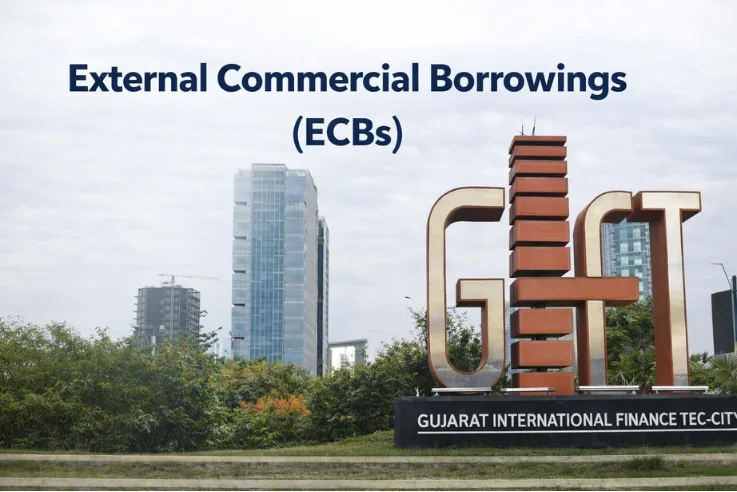
Dominating 65% of ECBs with Tax Benefits and Simplified Regulations
OVERVIEW
- India’s Gujarat International Finance Tec‑City (GIFT City) has rapidly become the dominant channel for External Commercial Borrowings (ECBs) raised by Indian corporates in the current financial year 2025–26.
- According to Reserve Bank of India (RBI) linked data, over 65 per cent of all ECB issuances so far, approximately $18 billion out of $27.5 billion raised between April and December 2025 were routed through the GIFT IFSC, up sharply from 36 per cent in FY25.
- This represents a significant increase in market share compared with the previous year. The trend is supported by competitive borrowing costs, streamlined operations, and favourable regulatory and tax measures.
Structural Shift
- GIFT City’s rising share in India’s ECB market signals a significant structural shift in how Indian entities access global capital.
- What was once an alternative funding route has become a preferred jurisdiction, driven by regulatory relaxations, tax advantages, and operational efficiencies.
- Companies are increasingly choosing GIFT City over traditional offshore financial centres such as London, Singapore, Hong Kong, and Luxembourg.
GIFT City’s Dominance in the ECB Market
- GIFT City now stands out as India’s principal offshore borrowing centre. It accounted for approximately $18 billion in ECBs between April and December 2025, or over 65% of the total $27.5 billion raised by Indian entities in that period.
- This share has nearly doubled compared with the earlier fiscal year. Cumulative ECBs booked through GIFT City’s IFSC reached around $55.7 billion by the end of December 2025.
- This growth is supported by a network of 35 IFSC Banking Units (IBUs) with combined assets close to $100 billion by Q2 FY26. These banks provide foreign currency lending in major currencies such as USD, EUR, and GBP to Indian corporates.
Structural Advantages
- The rise of GIFT City is not solely due to tax incentives. Its cost-efficient financing, operational ease, and reduced dependence on traditional offshore centers such as London, Hong Kong, Singapore, and Luxembourg are central drivers.
- The 2026 Union Budget extended the tax holiday for IFSC units to 20 consecutive years, followed by a 15% concessional tax rate, bringing long-term tax certainty.
- Experts highlight that compliance and disclosure processes for companies borrowing through GIFT City can be simpler than those in other international financial jurisdictions.
Conclusion
- GIFT City is poised for continued growth as a major hub for India's international capital flows.
- With a favorable regulatory environment, tax incentives, and simplified compliance processes, it is attracting more Indian corporates to raise funds via External Commercial Borrowings (ECBs).
- The Gift City’s role is expected to expand further, especially as India strengthens its presence in global financial markets.
- As the infrastructure for green and sustainability-linked financing continues to develop, GIFT City will likely play a central role in meeting the financing needs of Indian businesses, while contributing to the broader economic objectives of India.
For guidance on your specific situation, speak to our team.
← All insights